Backyard retaining walls for sloped yards in Cumming and Forsyth County
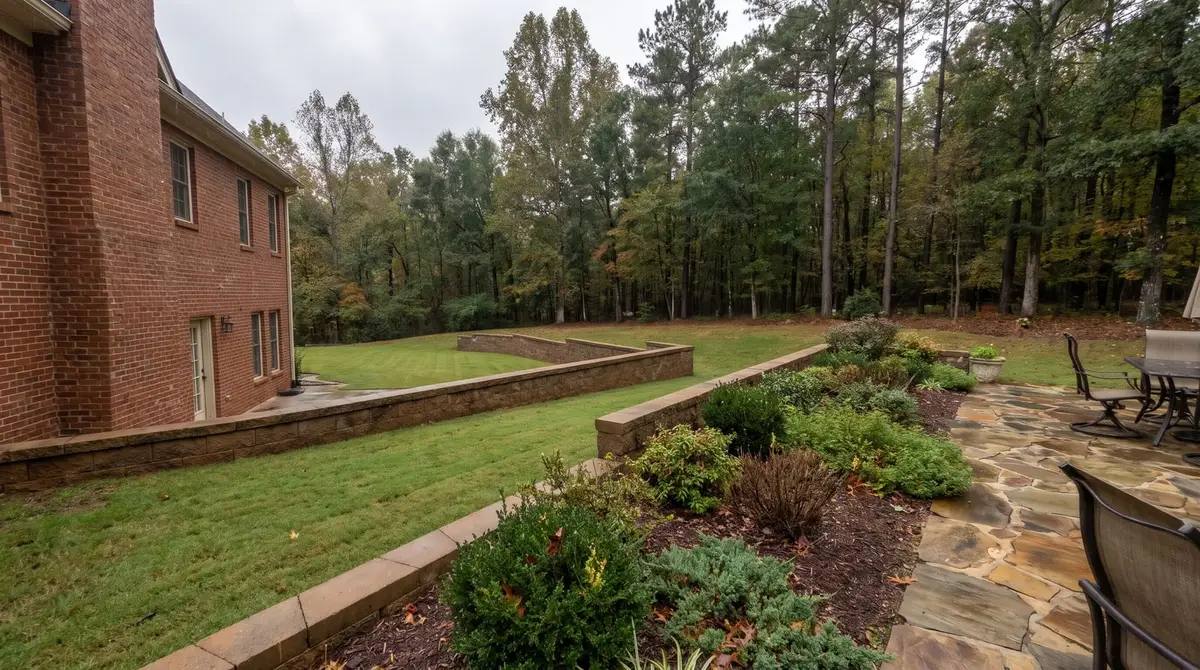
A lot of homes around Cumming back onto ground that falls away fast, leaving a yard too steep to use. A retaining wall can turn that hillside into a flat place for a patio, a play set or a garden. Whether one tall wall or two lower ones works better depends on your slope and your budget. As a rough guide, most retaining wall projects in the Atlanta area come in between $3,503 and $8,993, with bigger yards costing more.
Call (470) 281-3568Rather not call? Send the detailsCalls are answered weekdays, 9 to 6. After hours, leave your name, address and what's going on, and you'll get a call back first thing the next business day.
Why are so many Forsyth County backyards sloped?
The county sits in the Georgia Piedmont, on rolling ground cut by creeks and the ravines around Lake Lanier. The Corps of Engineers describes the shoreline topography as rolling to steep. The Madison soil series, common across the county, is mapped on slopes from 2 to as much as 60 percent.
Fast growth put many homes on that land. Forsyth's population went from 175,511 in 2010 to 251,283 in 2020, and the Census estimates 282,805 for 2025. When a lot is graded for a house, the flat ground usually goes to the house and drive, and the yard gets what's left.
One tall wall or two shorter walls?
| One tall wall | Two or more terraces | |
|---|---|---|
| Flat space | One big level area | Two smaller levels with a step |
| Look from the house | Can feel like a big face of block | Softer, with room for plants |
| Engineering | More likely to cross the height rules | Can still need analysis |
| Building cost | More per square foot when tall | More total wall length |
| Upkeep | One wall to watch | More beds to tend |
Terraces only count as separate walls under the county's code if the gap between them is greater than the height of the tallest section. Closer together, they're treated more like one wall. HomeGuide also notes that curves, steps and multiple tiers add installation time.
How do you figure out how much flat yard a wall gives you?
- Measure the drop: Run a string with a line level from the house side out to where the flat yard should end. The drop at the far end, in feet, is about how tall the wall will be.
- Do the math: If the yard falls 1 foot every 5 feet, a 4-foot wall gives about 20 feet of level ground. A steeper yard gives less per foot of wall.
- Leave room for the wall: The wall and gravel take up space, and geogrid can reach behind it. Keystone wants a 4-foot bench in front of a wall on a downslope.
- Plan the machine route: Ask how equipment will reach the back. A side yard with a gate or a septic field changes the plan and the price.
- Think about the fill: Filling behind a wall may take many truckloads, and the fill should be compacted in layers so the patio doesn't sink later.
What about water, septic and neighbors?
Regrading changes where the rain goes. A new flat area can hold water where it once ran off, and it can send more toward a neighbor. Plan for the surface water when you plan the wall. The page on wall drainage covers what should go behind it.
On a septic lot, county Environmental Health has to approve a permitted wall first, so find your drain field before you draw anything. If a creek crosses the back of your lot, Forsyth County keeps a 50-foot natural buffer and an added 25-foot setback from it, on top of the state's 25-foot buffer on state waters.
How much does a backyard retaining wall cost in Cumming?
Angi's Atlanta figure averages $6,167, with most projects between $3,503 and $8,993. HomeGuide's example for a wall 50 feet long and 4 feet tall is $7,000 to $13,000. Angi also says labor can rise by 50% or more on sloped lots, which describes most of the yards that need a wall.
A wall is usually just the start. Fill dirt, the patio or sod on top, steps down to the lower yard, and a fence or railing on a tall wall all add up. It's worth asking for those as separate lines so you can compare quotes.
Common questions
Do retaining walls add home value?
They can, by making more of the yard usable, but there is no reliable local number to quote. Most people build for the use of the yard and for stopping erosion.
What can I use instead of a retaining wall?
On a gentle slope, regrading and planting may be enough. Groundcover and shrubs can hold a slope that doesn't need to be level. A wall earns its cost when you need flat space or the slope is washing away.
Do I need a railing on top of a wall?
That depends on the height, where people will walk and local rules. Ask your contractor and the permit office, and think about children and pets even where no rule applies.
Can a pool go above a retaining wall?
It can, but that's a heavy load. Plan on an engineered wall designed for it.
Sources: Angi, Retaining wall cost in Atlanta (updated February 2026) (source); Angi, How much does it cost to build a retaining wall? (updated September 2026) (source); HomeGuide, Retaining wall cost (2026) (source); US Army Corps of Engineers, Lake Sidney Lanier Shoreline Management Plan (2004) (source); USDA NRCS, Official soil series description: Madison (source); US Census Bureau, QuickFacts: Forsyth County and Cumming (source); Forsyth County Unified Development Code, Chapter 16 (retaining walls in setbacks and terraces; third-party copy) (source); Forsyth County Unified Development Code, Chapter 18 (stream buffers; third-party copy) (source); O.C.G.A. 12-7-6: 25-foot buffer along state waters (third-party copy) (source); Keystone Retaining Walls, Construction manual: installation (source); Forsyth County, Fence and retaining wall permit packet (revised January 2025) (source).
Last reviewed November 5, 2026.
Rather not call? Send the details
A local retaining wall pro will call you back.