Block retaining walls in Cumming and Forsyth County
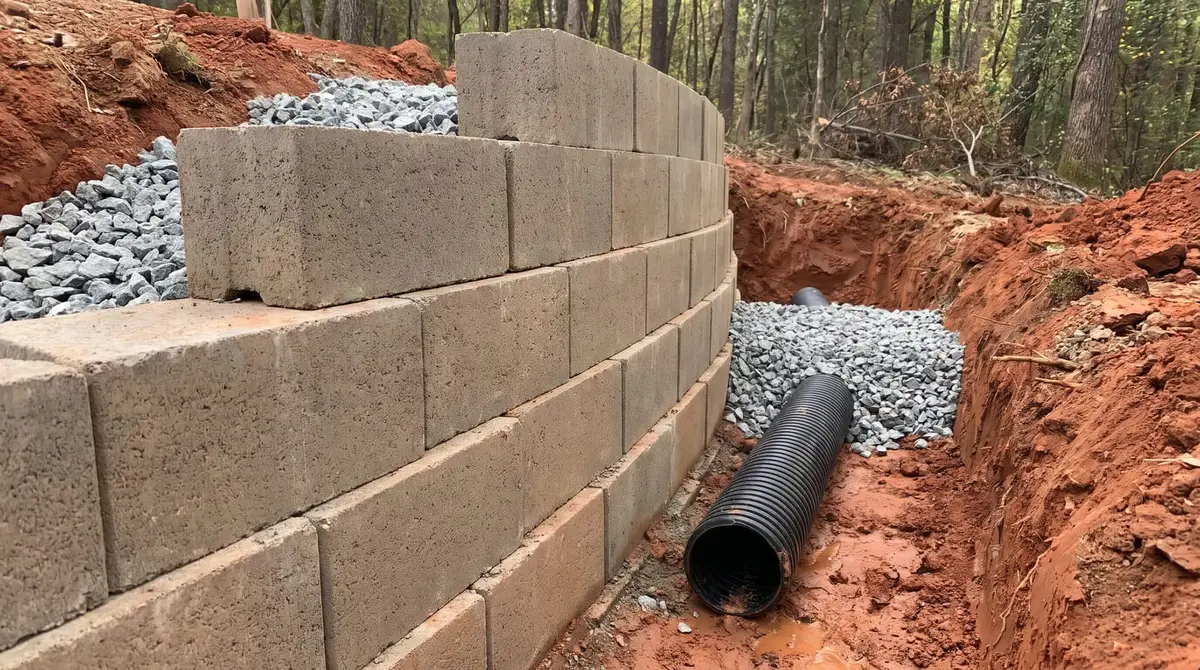
Stacked concrete block is the most common wall on a Forsyth County lot, and for good reason: the units fit together without mortar, come in many colors and faces, and a crew can build around curves. HomeGuide calls segmental walls the most popular choice for homes. A rough price is $15 to $40 a square foot. What decides whether a block wall lasts is mostly what you can't see: the base, the gravel and the drain.
Call (470) 281-3568Rather not call? Send the detailsCalls are answered weekdays, 9 to 6. After hours, leave your name, address and what's going on, and you'll get a call back first thing the next business day.
Which kind of block wall fits the job?
| Type | Good for | What holds it up |
|---|---|---|
| Small landscape block | Garden beds and low borders | Its own weight |
| Segmental block | Most yard walls | Its weight, plus geogrid when taller |
| Large precast block (such as Redi-Rock) | Big grade changes and tight spaces | Very heavy units, placed by machine |
The words a contractor might use: "segmental" or "SRW" means dry-stacked interlocking units; "modular block" means roughly the same thing; "gravity wall" means one that stands by weight alone. Large precast walls can reach about 18 feet without reinforcement, by Redi-Rock's own figure, under the right soil conditions. That's a manufacturer's limit, not a rule for your yard.
How is a segmental block wall built?
- Mark the lines: Georgia law requires a Georgia 811 request at least 3 business days before digging with machinery. It's free.
- Dig the trench and base: Allan Block calls for at least 6 inches of compacted wall rock, in a trench deep enough to bury part of the first course. Heavy clay or wet soil under the base comes out and is replaced with granular material.
- Bury the first course: The common minimum is 6 inches below grade. Allan Block's rule adds 1 inch per foot of wall height.
- Stack with the setback: Each course steps back slightly into the hill, built into the block's shape.
- Gravel and pipe behind it: At least 12 inches of clean gravel directly behind the block, with a drain pipe at the bottom that runs to daylight.
- Backfill and cap: Soil goes in compacted layers, topped with a cap and sloped so surface water runs away from the wall.
When does a block wall need geogrid?
HomeGuide says segmental walls generally handle up to 3 or 4 feet without reinforcement. Above that, or with a driveway or a steep slope above the wall, the design usually adds geogrid: sheets of plastic mesh laid into the soil behind the wall to tie a big block of earth to it.
Allan Block's guidance sets grid length at 60% of the total wall height and vertical spacing at no more than two courses. Those are starting points. The design for a tall wall comes from an engineer, who works from your soil and load. See the page on engineered walls and permits.
What about the red clay under a Cumming block wall?
Clay shapes two parts of the job. Used as backfill, clay holds water against the wall, so the gravel zone matters more than on sandy ground. Allan Block prefers free-draining fill with less than 10% fines. Under the base, soft or wet clay needs to be dug out. Removing it costs money up front, and a quote that doesn't mention it is worth asking about.
The slope below the wall matters too. Keystone's manual asks for at least a 4-foot flat bench in front of the wall where the ground drops away.
How much does a block retaining wall cost in Forsyth County?
HomeGuide puts a concrete block wall at $15 to $40 a square foot of wall face. LawnStarter's interlocking block row is $15 to $35. To figure the square feet, multiply length by height: a wall 50 feet long and 4 feet tall has 200 square feet.
Whole projects run higher than the block price alone, with footings, drainage and access added. HomeGuide's example for that 50-foot, 4-foot wall is $7,000 to $13,000. Angi notes that sloped lots can push labor up by 50% or more, and that's common around Cumming.
Common questions
How long does a block retaining wall last?
HomeGuide lists concrete walls at 50 to 100 years. Those numbers assume a sound base and working drainage. Most early failures come from water, not worn-out block.
Do block walls need mortar?
Segmental walls don't. The blocks lock together by shape and weight, and the small gaps let water out. That's different from a mortared cinder block wall.
Does a 3-foot block wall need drainage?
Allan Block requires a drain pipe on any reinforced wall and on gravity walls over 4 feet, and gravel behind the block on all of them. With clay and wet weather here, it's worth asking for a pipe on shorter walls too.
What block style should I pick?
Choose the system by the height and load first, then the look. Most makers offer several faces and colors within a system.
Sources: HomeGuide, Retaining wall cost (2026) (source); LawnStarter, How much does a retaining wall cost in 2026? (source); Angi, How much does it cost to build a retaining wall? (updated September 2026) (source); Allan Block, Basic residential installation (source); Allan Block, Best practices for segmental retaining walls (source); Allan Block, Best practices for SRW walls (PDF): geogrid (source); Keystone Retaining Walls, Construction manual: installation (source); Redi-Rock, Engineering and structural limits FAQ (source); Redi-Rock, What is a gravity retaining wall? (source); Georgia 811, The 811 process (source).
Last reviewed November 5, 2026.
Rather not call? Send the details
A local retaining wall pro will call you back.