Retaining wall repair in Cumming and Forsyth County
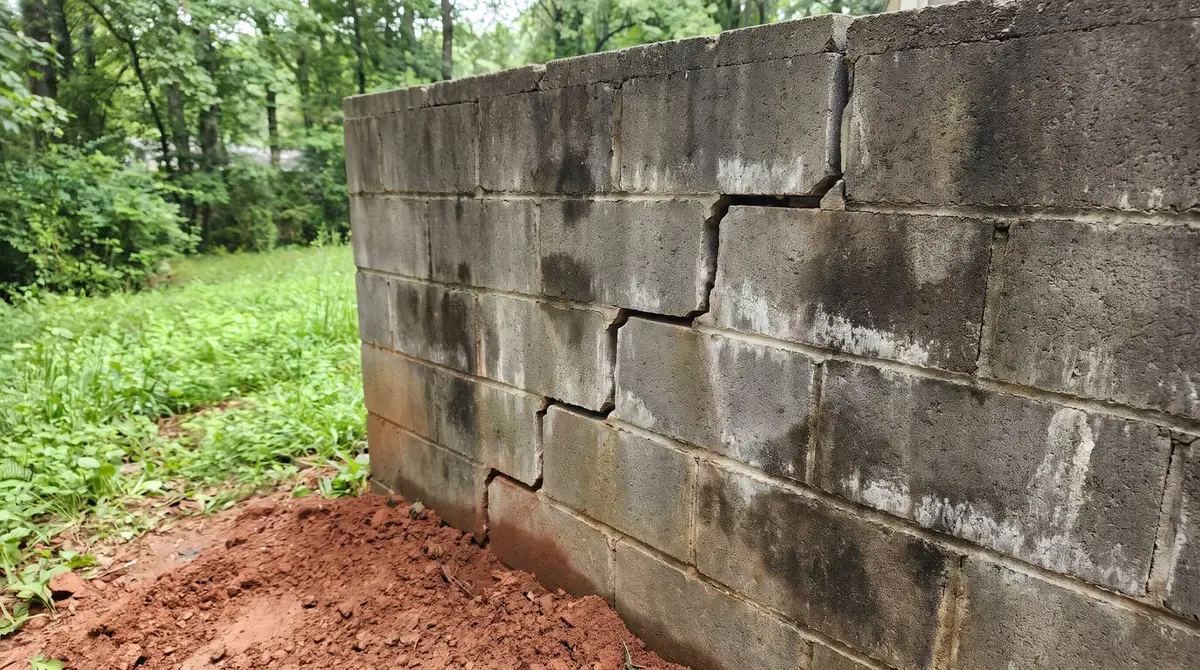
A wall rarely fails all at once. It starts leaning, grows a belly, or cracks along a joint, and most of the time water is behind it. Whether it can be repaired depends on why it moved. Small repairs often run a few hundred dollars. A wall that has lost its footing may need to come down and be rebuilt, and on a tall wall above a driveway or a neighbor, it makes sense to have someone look soon.
Call (470) 281-3568Rather not call? Send the detailsCalls are answered weekdays, 9 to 6. After hours, leave your name, address and what's going on, and you'll get a call back first thing the next business day.
What do the warning signs on a retaining wall mean?
| What you see | What it often points to | Rough repair cost |
|---|---|---|
| Leaning or bowing | Pressure behind the wall, often wet soil | $275 to $1,200 |
| Shifted at the base | The footing or base has moved | $650 to $1,200 |
| Wet face or seeping joints | Water with no way out | $220 to $990 |
| Cracks and crumbling | Weather, erosion or age | $335 to $1,100 |
HomeGuide suggests looking a wall over twice a year for cracks, bulging and water stains. White residue on the face is a clue too: it's left behind when water moves through the wall. A photo taken from the same spot every few months makes slow movement easy to see.
Why do so many walls in Forsyth County end up leaning?
Mostly water and clay. Red clay is the signature subsoil here, in the Madison and Cecil soils common across the county, and clay holds water. As Cat's guide on wall myths puts it, clay "retains water," and wet soil pushes far harder than dry soil. This Old House's Roger Cook says the weight of wet soil can topple even the sturdiest wall.
Rain doesn't help. NOAA's normal for the Cumming station is 56.37 inches a year, against 50.43 at the Atlanta airport. A wall put up without gravel and a drain gives all that water nowhere to go except against the back of the wall.
Repair or rebuild: how does a pro decide?
- Find the cause: Clogged weep holes or a blocked pipe are cheap to fix. A wall that was built with no drain at all is a bigger job, because the backfill has to come out.
- Check the base: If the bottom course has moved or sunk into soft ground, patching higher up won't last.
- Measure the movement: A small lean that has stopped is different from one that grows each season. Earlier photos help.
- Look at what's above and below: A driveway, a house or a neighbor's fence near the wall raises the stakes. HomeGuide suggests a structural engineer when the cause isn't clear.
How much does retaining wall repair cost in Cumming?
Angi's national average for a repair is $700, with most falling between $450 and $950. HomeGuide's wider range is $100 to $1,500. Those are for fixing a section, not replacing the wall.
When a wall has to come out, HomeGuide prices a 50-foot wall, 4 feet tall, at $6,000 to $14,000 all in: $2,000 to $4,000 to tear out and $4,000 to $10,000 for the new wall. Getting an engineer to look runs roughly $100 to $220 an hour, by Angi's figures.
Does a repair need a permit in Forsyth County?
The county's permit trigger is a wall over 6 feet, measured from the bottom of the footing, and a wall that size must be engineered. Inside Cumming, the city has its own fence and retaining wall permit. Rebuilding a wall may be treated differently from patching one, so ask the county or city about your exact job before work starts. The Forsyth permit packet puts the job of checking setbacks on the owner.
Common questions
Is a leaning retaining wall dangerous?
It can be, depending on its height and what is above or below it. A low garden wall tipping a little is a different problem from a tall wall holding up a driveway. If it is moving quickly, keep people and cars clear and get it looked at.
Can I fix a retaining wall myself?
Small things, yes: clearing weep holes, resetting a loose cap, moving a downspout away. Rebuilding a section of a tall wall is a different job, and a wall over 6 feet in Forsyth County needs a permit and an engineer.
Can a bulging wall be pushed back into place?
Usually not in a lasting way unless the pressure behind it is dealt with. Most fixes take down the bad section, add gravel and drainage, and put it back.
Who fixes retaining walls?
Hardscape and masonry contractors do most of them. For a tall wall or an unclear cause, a structural or geotechnical engineer looks first and the contractor works from that plan.
Sources: Angi, Retaining wall repair cost (updated October 2026) (source); HomeGuide, Retaining wall repair cost (2026) (source); HomeGuide, Retaining wall cost (2026) (source); USDA NRCS, Official soil series description: Madison (source); USDA NRCS, Official soil series description: Cecil (source); Cat, Top 11 myths about building a retaining wall (source); This Old House, All about retaining walls (source); NOAA, 1991 to 2020 climate normals: Cumming 2N and Atlanta (source); Forsyth County, Fence and retaining wall permit packet (revised January 2025) (source); City of Cumming, Fence and retaining wall permit application (2026) (source).
Last reviewed November 5, 2026.
Rather not call? Send the details
A local retaining wall pro will call you back.