Retaining wall drainage in Cumming and Forsyth County
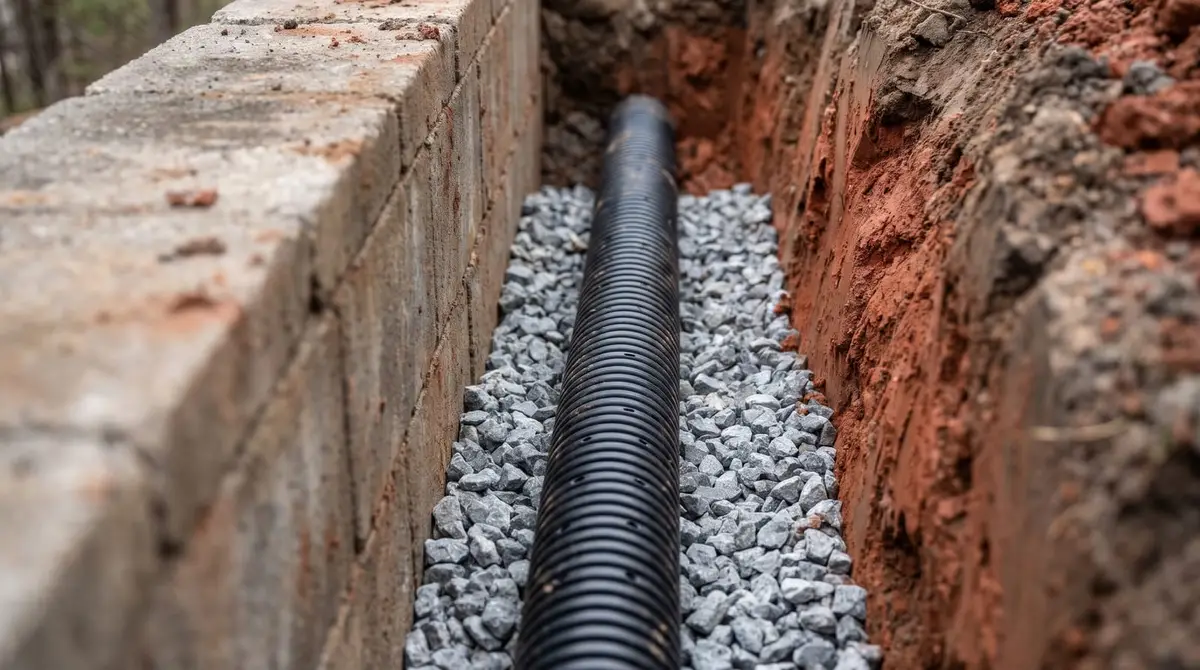
If a wall in Cumming is leaning, wet or staining, start by asking where the water goes. Soil soaked with rain pushes hard against the back of a wall, and clay holds on to that water. Drainage is the part of the wall nobody sees, which makes it the easiest part to leave out. Adding it to an existing wall often means digging behind it, at roughly $60 to $70 a foot.
Call (470) 281-3568Rather not call? Send the detailsCalls are answered weekdays, 9 to 6. After hours, leave your name, address and what's going on, and you'll get a call back first thing the next business day.
Why does water push over retaining walls?
HomeGuide puts it simply: drainage prevents the hydrostatic pressure that can make walls bow, crack or collapse. Allan Block adds that typical design methods often overlook those water forces. And Cat's guide calls water a lubricant for soils: wet ground not only weighs more, it also slides more easily.
That's a real concern around Cumming. The Madison and Cecil soils common in the county have red clay below the surface. USDA rates the soils as a whole as well drained, but UGA's extension notes that this clay retains water and drains poorly once water reaches it. Behind a wall, it acts like a wet sponge. NOAA's normal for the Cumming station is 56.37 inches of rain a year.
What should be behind a retaining wall?
- A gravel zone: Allan Block calls for clean gravel in the first 12 inches behind the wall, sized about 1/4 to 1-1/2 inches with few fines.
- A drain pipe at the bottom: Perforated pipe at the base and behind the wall. Allan Block requires one on any reinforced wall and on gravity walls over 4 feet.
- A way out: The pipe has to reach daylight, with outlets about every 50 feet by Allan Block's guidance. A pipe with no outlet just stores water.
- Fabric where needed: This Old House wraps the pipe in landscape fabric to keep soil out. Allan Block doesn't call for fabric on a typical wall, so practice varies by system.
- Surface water sent away: Cat advises pitching the ground to carry water at least four feet away from the wall. Downspouts shouldn't empty behind it.
How can I tell whether my wall has drainage?
| What to check | A good sign | A bad sign |
|---|---|---|
| Pipe outlet at the low end | Water trickles out after rain | No outlet, or it's crushed or buried |
| Weep holes on a solid wall | Open, with a little flow | Packed with dirt or none at all |
| Face of the wall | Dries soon after the rain | Stays dark, or shows white residue |
| Ground behind the top | Firm and sloped away | Soft, sunken or holding puddles |
| Downspouts nearby | Piped well past the wall | Emptying right behind it |
A wall can't always answer this from the outside. A pro may dig a small test hole behind the wall to see what's back there.
Can drainage be added to an existing wall?
Often, yes, if the wall hasn't already moved much. Start with the cheap things: clearing weep holes, moving downspouts and regrading so the surface water goes elsewhere. If that doesn't solve it, the soil behind the wall comes out, gravel and pipe go in, and clean soil goes back on top.
If a wall has already leaned a lot, it usually makes more sense to take down that section and rebuild it with drainage. See retaining wall repair for how a pro decides.
How much does retaining wall drainage cost in Cumming?
Angi prices fixing drainage on a wall at about $60 to $70 a foot. HomeGuide's repair guide lists adding drainage at $50 to $80 a square foot of wall, while a French drain ranges from $10 to more than $85 a foot, depending on depth and access. For a new wall, gravel and pipe should be in the base price, so ask for them in writing.
What raises the number on an existing wall is getting to it: fences, patios, plantings or a pool deck behind the wall may have to come out first.
Common questions
Do you have to put gravel behind a retaining wall?
For a block or boulder wall, yes. It's how water reaches the drain instead of pushing on the wall. Clay backfill right against the wall traps water.
Does a 3-foot wall need a drain?
Allan Block requires a drain pipe on any reinforced wall and on gravity walls over 4 feet, so a short gravity wall may not strictly need one. It still needs gravel. With clay and this much rain, a pipe is cheap insurance.
What are weep holes for?
They let water out through a solid wall. They clog over time, so clear them when you see no flow after a hard rain.
Where can the drain empty?
To daylight at a lower part of your lot, without sending the water onto a neighbor. In Forsyth County, work near a stream has its own buffer rules.
Sources: HomeGuide, Retaining wall cost (2026) (source); HomeGuide, Retaining wall repair cost (2026) (source); Angi, How much does it cost to build a retaining wall? (updated September 2026) (source); Allan Block, Basic residential installation (source); Allan Block, Best practices for segmental retaining walls (source); Cat, Top 11 myths about building a retaining wall (source); This Old House, All about retaining walls (source); USDA NRCS, Official soil series description: Madison (source); USDA NRCS, Official soil series description: Cecil (source); University of Georgia CAES, Even in a heat wave, don't overwater your plants (source); NOAA, 1991 to 2020 climate normals: Cumming 2N and Atlanta (source); Forsyth County Unified Development Code, Chapter 18 (stream buffers; third-party copy) (source).
Last reviewed November 5, 2026.
Rather not call? Send the details
A local retaining wall pro will call you back.